Showing posts with label sustainable. Show all posts

Thursday, June 25, 2009

Villa Santai, Bali's Green Roof

When people think of Bali, Indonesia, warm breezes, and a beautiful, unspoiled setting come to mind. Relaxing in such a beautiful setting is a dream for many, and a reality for just a few.

Victor Sinclair decided this was a place he wanted live and dream, while enjoying green roofs! His website starts with an excellent quotation that sets the stage for why he built Villa Santai with green roofs:

“ The nature that we have on the roof, is that piece of nature that we murdered, when put the house there ” , Friedenreich Hunderwasser, the leading architect for green roofs in the 1960's – 1980's.

Particular to this site are the ways Villa Santai manages water. Subject to monsoons and dry seasons, the Villa has a series of water storage tanks to capture heavy rains. While the green roofs take up some of the rain, the rest is divided for different purposes. In one tank, the water is filtered for drinking water. The other two tanks are used to recycle waste water, which goes to to maintain the plants. Water Barrels and Storage

The green roofs for the Villa specifically reduce the interior heat of the living area, which in tropical Bali is a must! Additionally, outside of the 36 acre lot, the major form of transportation is motorcycle or scooter. The green roofs help reduce the noise as people motor past. $20 Off AeroGardens

Found in the beauty of Bali, Villa Santai is an excellent example of using sustainable building, green roofs, and water conservation in a luxury setting. In addition to Victor's website, I highly recommend his article on greenroofs.com.

Save up to 60% on your All Inclusive Vacation!

Wednesday, April 1, 2009

The UK's Greenest Hospital

World Architecture News reports:

Construction has begun on the first phase of the new, £300m Mittal Children’s Medical Centre at Great Ormond Street Hospital for Children NHS Trust (GOSH), which is on target to become the UK’s ‘greenest’ medical building to date.

GOSH sought to have the building be a leader in sustainable development and includes many green components. Mountain House Freeze-Dried Food

Working with the architectural firm of Llewelyn Davies Yeang (LDY), GOSH is estimated to reduce about 20,000 tons of CO² annually. This reduction is also part of "...GOSH’s targets of a 120% carbon reduction and 60+ per cent renewable energy contribution by 2016, when Phase 2 of the project is due to complete."

LDY is noted as being a "deep green" design firm, with projects in over 15 countries. Not only do they design building with green components but also develop "eco design strategies" for their clients.

The building will include glazed glass panels to bring in a significant amount of natural, while also deflecting the heat from the increased amount of light. The building will also include significant amounts of natural ventilation, reducing the HVAC loads typical in buildings of this size (30,000 sq m). While the picture appears to show a green roof, I haven't been able to find supporting documentation. However, it would be consistent with LDY to have a green roof, as they have included them on many of their projects. Further, a green roof on a hospital would provide a peaceful respite from the stress of medical care, as well as further reducing HVAC costs. Cheap? No. 100% Free. Trade stocks for free on Zecco.com. The Free Trading Community.

The growth and renovation of this hospital is due in part to a generous donation of £15 million donation from the Aditya and Megha Mittal family.

Tired of Being Tired?

Tuesday, February 10, 2009

Hyderabad's Greenest Roof

Many of the green roof projects I have written about are designs that haven't been completed, like Dongtan in China and
the Eco Bay Complex in Abu Dhabi.

However, the CII-Sohrabji Godrej Green Business Centre (GBC) opened in Hyderabad, India in 2004! I found a press release at the Indian Brand Equity website discussing the opening of the project.

At the time of its opening, it was the only LEED Platinum building outside of the US.

One of the key aspects of the building is its zero discharge of water. In India, where clean water is not readily available and the monsoon season overwhelms the limited water treatment facilities, the ability to capture and recycle all water is exceptionally significant. Additionally, the green roof helps reduce the cost of air conditioning, desperately needed in such a hot climate.

Other elements of green building used for the GBC include the use of recycled materials, such as fly ash, as well as photovoltaic cells for solar energy.

This project received funding support from the US taxpayers in the form of a matching grant of $1.2 million over three years.

According to the US Embassy in New Dehli,
"The grant will assist the centre as it develops detailed plans for each major area, including green buildings, green business incubation, and water and energy conservation."

India has demonstrated its desire and capacity to build green buildings. Let's hope to see more green roofs like the Chennai Airport and the GBC in the future!

Thursday, January 15, 2009

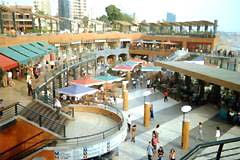
Green Roof in Lima, Peru

In my previous posts, I have discussed green roofs from all parts of the world, though there has been a strong emphasis on China. Part of this emphasis has been that China is in desperate need of cleaner air, and there appears to be a desire to build more sustainable buildings. $20 Off AeroGardens

However, there are wonderful examples of green roofs throughout the world. This post's example comes from Lima, Peru. According to LivingRoofsinc.com, the picture at the top left is of the LarcoMar commercial center. What looks like just a city park is actually an extensive green roof. LarcoMar is a very popular tourist destination built into the cliffs that bound the Pacific Ocean. It is also home to very high-end retail. Organic Flowers & Gourmet Gifts

So, if you are Lima and looking for that new Versace bag, stop by and see the beauty of this great green roof!

Modern Bedroom  free shipping on orders over $200

Friday, August 22, 2008

A New Green City for China, Interview Part II

As I have written in the three previous articles (here, here, and here), Dongtan is going to be "...a city powered by local, renewable energy, with super-efficient buildings clustered in dense, walkable neighborhoods; a recycling scheme that re-purposes 90 percent of all waste; a network of high tech organic farms; and a ban on any vehicle that emits CO2."
To get more information about the project, I have conducted an interview with Arup, the city designer. This is the second of two articles with details from the interview.

So, how does this type of dream city actually get built? The simple answer is money. HSBC and Sustainable Development Capital LLP (SDCL) are going to provide the majority of financing for the development. Both of these companies are natural contributors for this project.

From the HSBC website, "The HSBC Group is named after its founding member, The Hongkong and Shanghai Banking Corporation Limited, which was established in 1865 to finance the growing trade between China and Europe." SDCL, from its site, "SDCL has an exclusive focus on projects which it considers: Have a positive environmental and social impact; Can create attractive levels of return on investment (commercial sustainability); and Are potentially transformational."

Continuing with the theme of balance between sustainability and Chinese design, it also helps to consider the philosophy of Mao Tse-tung, which considered nature an obstacle, and that of Hu Jin Tao, which declared the necessity for ecological balance and sustainability. In both cases, Dongtan will be the area to find that balance, both to sustain a growing population, as well as maintaining the highest ecological standards possible.

The final question I asked was whether Arup was persuing other similar projects? They highlighted two projects, Wanzhuang, in China and Treasure Island Community Development (TICD) in San Francisco. In both cases, sustainability, renewable energy, and ecological protection are the main drivers in the development.

I congratulate all of the parties involved in the Dongtan project and give my best wishes for their success. Further, I would like to thank Arup and its Press Office for being so generous with their time. As the project progresses, it is my intent to provide updates. Additionally, I will do the same for Wanzhuang and Treasure Island.

Wednesday, August 20, 2008

A New Green City for China, Interview Part I

As I have written in two previous articles (here and here), Dongtan is going to be "...a city powered by local, renewable energy, with super-efficient buildings clustered in dense, walkable neighborhoods; a recycling scheme that re-purposes 90 percent of all waste; a network of high tech organic farms; and a ban on any vehicle that emits CO2."
To get more information about the project, I have conducted an interview with Arup, the city designer. This is the first of two articles with details from the interview.

As previously mentioned, the development is being led by the Shanghai Industrial Investment Corporation (SIIC). My first question was why China wants to build a "green" city, with all of the sustainable elements. The answer can be found in a speech by Chinese President Hu Jintao, at the 17th National Congress. While I am not fond of communist propaganda, he does mention several times the need to improve environmental conditions and reduce pollution.

The second question was why Arup was chosen. While the SIIC didn't comment specifically, Arup has over 30 years experience working in China and also uses a system called Integrated Resource Management (IRM), which is a tool to optimize land use. This tool accounts for water, waste, energy, and living space necessary on a given piece of land. In this case, Dongtan is projected to hold 500,000 people at capacity.

One item that will make this city unique is that Arup has provided a design specification for types of buildings. The specifications allow designers, architects, and developers to provide structures that reflect the Chinese character of Dongtan, while creating a sustainable, green living space. Many of these buildings will also have green roofs! Green roofs reduce utility costs, storm water runoff, as well as CO2 and air pollution. Green roofs also can provide aesthetic benefits for those living in and around the buildings. Since no building will be much over eight stories, these roofs should be visible from street level.

The next article will cover questions regarding financing partners, the potential for similar projects, as well as the public response. Many thanks to Arup for participating in the interview process.

Click here to read the second part of the interview.

Monday, July 14, 2008

Chicago Museum Showcases Green Roof Home

The Chicago Museum of Science and Industry are holding an exhibit of a "green" home, complete with a flat green roof! The exhibit runs through January 04, 2009 and highlights not just the green roof, but photovalic film for solar electricity, and sustainable landscaping, just to name a few items.

The home is 2500 square feet, and three stories high. It was built by Michelle Kaufmann Designs of Oakland, California, and builder, All American Homes of Decatur, Indiana.

These types of exhibits will hopefully demonstrate to the viewing public the viability of flat green roofs not just for commercial structures, but also for homes.