Showing posts with label Dongtan. Show all posts

Monday, August 24, 2009

Germany's ECO CITY

Germany, already a leader in green roofs, is now working on its own ECO CITY. Full of green roofs, wind turbines, and other sustainable technologies, ECO CITY hopes to revive the historic Hamburg-Harburg Harbor.

Total Gym® Home Fitness Equipment - Over 1 Million Satisfied Customers. Get the Body You've Always Wanted!

Hamburg-Harburg Harbor, situated on the North Sea, has been a hub of trade and industrial activity since the 19th century. Although the original factories have since left, the historic area still has many classic buildings that ECO CITY wishes to retain and reuse in the renovated and sustainable city.

Site reclamation and renovations are difficult enough, however, ECO CITY takes this project to the next level. Inhabitat.com and World Architecture News both report one of ECO CITY's goals is to achieve certification from the three leading "green" building bodies (from WAN):

"...USGBC’s Leadership in Energy and Environmental Design (LEED) Program, the Building Research Establishment Environmental Assessment Method (BREEAM), and the German Sustainable Building Council (DGNB)’s Program. Currently, ECO CITY is seeking the highest level of environmental certification from all three programs."

On sale at VivaTerra. Save up to 70% on natural home décor, organic gifts and more.

To achieve top marks from each of these bodies, buildings must produce renewable energy, be built with recycled materials, and use the renewable energy to sustain the project, e.g., solar lights, passive cooling, etc.

Green roofs are a key element of the project, not only to reduce storm water runoff, but also to improve the quality of life of the workers in the area. ARUP, the designers of Dongtan, the green city in China, is one of the key developers of ECO CITY. Their experience with green building, and Dongtan in particular, will help make ECO CITY a success.

Inhabit Pillows - Modern Design!

Monday, June 8, 2009

Masdar, the Green City for Abu Dhabi

While I have written about green cities in the past, Dongtan, in particular, the only city that has started construction is Masdar, in Abu Dhabi.

Designed for 40-50,000 residents and another 50,000 commuters, Masdar will utilize solar as its primary electricity source. The first 10 MW power station went online in January 2009, according to UAE Interact.

Additional green features include grey-water recycling systems, an highly-efficient desalination plant, as well as "... the world’s largest solar thermal driven cooling and dehumidification system. " In addition to green systems for electricity and water, the building materials themselves had to be green. The steel had to be recycled steel, as well as the aluminum. Discover Top Rated Mighty Leaf Herbal Tea. Tea lovers love our delicious herbal tea blends. You will too. Save 25% on your first order!

Another interesting highlight of the city, besides having no cars and the use of "personalized rapid transport pods," is the planned use of sequestered CO2 to improve the efficiency of oil drilling.

Although green roofs don't appear in the plan, the volume of flat roofs is significant. The need for electric power determined the use of the flat roofs, instead of green roofs. Additionally, green roofs in the desert aren't efficient, as they required significant water resources. Indoor gardens.

The city was designed by Foster and Partners of London.

Tired of Being Tired?

Wednesday, October 8, 2008

Another Green City for China

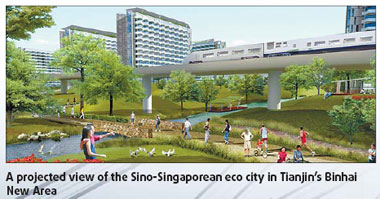
In the 9/25/2008 issue of "China Daily," there is an article titled "China Singapore Team Up on Green City Project."

China, in cooperation with Singapore, is looking to build a new, green city on a piece of land that would otherwise be unsuitable for habitation.

From the article: "The eco city is located in Tianjin's Binhai New Area. It will cover a total of 30 sq km - 20 sq km in Hangu district and 10 sq km in Tanggu district. It is 15 km from the central part of the Binhai New Area, 45 km from downtown Tianjin, and 150 km from Beijing."

The planners are estimating a population of approximately 350,000 when complete in 10-15 years. Additionally, it will have five commercial centers.

From a sustainability point of view, "Clean energy and renewable energy resources - such as wind power, solar energy, underground heat pump and air source heat pump - will reduce carbon emissions in the city. All the buildings in the eco city will have to conform to green architectural design standards." Green roofs are included in the design.

This is the latest in a green building boom in China. Shanghai working on a green roof program, Dongtan is the green city in southern China, and Songjiang, the new green resort being built. In each of these cases, green roofs play a key role in reducing air pollution, the urban heat island effect, storm water runoff, as well as improved energy efficiency.

Tuesday, September 16, 2008

Greening Kuwait

Lest people believe that green roofs are only used in Mexico City, Shanghai, Dongtan, or Chicago, Atkins Design of Epsom, UK has "...recently received the honour of CNBC Arabian Property Award High Rise Architecture Award" for the Al Sharq Office Complex in Kuwait. This was reported in World Architecture News.com.

From the article:

"The Al Sharq office building quietly pursues a rigorous sustainability agenda. A shallow plan office floor plate with heavily shaded facades reduces the tower's environmental footprint... The 180m tower will cover an area of 56,400sq.m and ... offers a variety of scenarios for business within a sustainable and environmentally responsible design."

As one can see from the artist's rendition, there will be what are refered to as "roof gardens" to provide shade and fresh air. While not displayed, this author hopes some form of green roof will be available, though given the climate, watering would be required.

Although storm water runoff management is not as significant an issue in Kuwait as it would be in Chennai, the reduction of fine particulate air pollution is certainly a benefit.

Jetsongreen.com
provides this quotation from Nicholas Bailey of Atkins: "This is a green building - literally - because of its foliage camouflage. Vertical fins to the street elevation, formed in colored glass, are fitted with integrated solar panels that contribute to the building's energy needs."

One hopes that other countries such as the U.A.E., Qatar, and Saudi Arabia consider using green roofs and green building in their current and future construction.

Friday, August 22, 2008

A New Green City for China, Interview Part II

As I have written in the three previous articles (here, here, and here), Dongtan is going to be "...a city powered by local, renewable energy, with super-efficient buildings clustered in dense, walkable neighborhoods; a recycling scheme that re-purposes 90 percent of all waste; a network of high tech organic farms; and a ban on any vehicle that emits CO2."
To get more information about the project, I have conducted an interview with Arup, the city designer. This is the second of two articles with details from the interview.

So, how does this type of dream city actually get built? The simple answer is money. HSBC and Sustainable Development Capital LLP (SDCL) are going to provide the majority of financing for the development. Both of these companies are natural contributors for this project.

From the HSBC website, "The HSBC Group is named after its founding member, The Hongkong and Shanghai Banking Corporation Limited, which was established in 1865 to finance the growing trade between China and Europe." SDCL, from its site, "SDCL has an exclusive focus on projects which it considers: Have a positive environmental and social impact; Can create attractive levels of return on investment (commercial sustainability); and Are potentially transformational."

Continuing with the theme of balance between sustainability and Chinese design, it also helps to consider the philosophy of Mao Tse-tung, which considered nature an obstacle, and that of Hu Jin Tao, which declared the necessity for ecological balance and sustainability. In both cases, Dongtan will be the area to find that balance, both to sustain a growing population, as well as maintaining the highest ecological standards possible.

The final question I asked was whether Arup was persuing other similar projects? They highlighted two projects, Wanzhuang, in China and Treasure Island Community Development (TICD) in San Francisco. In both cases, sustainability, renewable energy, and ecological protection are the main drivers in the development.

I congratulate all of the parties involved in the Dongtan project and give my best wishes for their success. Further, I would like to thank Arup and its Press Office for being so generous with their time. As the project progresses, it is my intent to provide updates. Additionally, I will do the same for Wanzhuang and Treasure Island.

Wednesday, August 20, 2008

A New Green City for China, Interview Part I

As I have written in two previous articles (here and here), Dongtan is going to be "...a city powered by local, renewable energy, with super-efficient buildings clustered in dense, walkable neighborhoods; a recycling scheme that re-purposes 90 percent of all waste; a network of high tech organic farms; and a ban on any vehicle that emits CO2."
To get more information about the project, I have conducted an interview with Arup, the city designer. This is the first of two articles with details from the interview.

As previously mentioned, the development is being led by the Shanghai Industrial Investment Corporation (SIIC). My first question was why China wants to build a "green" city, with all of the sustainable elements. The answer can be found in a speech by Chinese President Hu Jintao, at the 17th National Congress. While I am not fond of communist propaganda, he does mention several times the need to improve environmental conditions and reduce pollution.

The second question was why Arup was chosen. While the SIIC didn't comment specifically, Arup has over 30 years experience working in China and also uses a system called Integrated Resource Management (IRM), which is a tool to optimize land use. This tool accounts for water, waste, energy, and living space necessary on a given piece of land. In this case, Dongtan is projected to hold 500,000 people at capacity.

One item that will make this city unique is that Arup has provided a design specification for types of buildings. The specifications allow designers, architects, and developers to provide structures that reflect the Chinese character of Dongtan, while creating a sustainable, green living space. Many of these buildings will also have green roofs! Green roofs reduce utility costs, storm water runoff, as well as CO2 and air pollution. Green roofs also can provide aesthetic benefits for those living in and around the buildings. Since no building will be much over eight stories, these roofs should be visible from street level.

The next article will cover questions regarding financing partners, the potential for similar projects, as well as the public response. Many thanks to Arup for participating in the interview process.

Click here to read the second part of the interview.

Friday, August 15, 2008

A New Green City for China, Dongtan Videos

Below, you will find a three videos about Dongtan, the city in the previous post, "A New Green City for China." Don't forget to also read the interview articles either (Part I, Part II)!

The first video is part one of Alejandro Gutierrez, Program Designer at Arup, talking about Dongtan. The second video is the second half. They are a little hard to hear, but worth the effort.

The third video is a fly-over video, providing an artists impression of what the city will look like.

Please note that I am working on a series of interviews with Arup to further explain the project.


Friday, August 8, 2008

A New Green City for China

**Be sure to read the update with Interview 1, Interview 2, and videos. **
Shanghai has a growing population, heavily polluted air, dirty water, and power shortages. But just a short ferry ride away is a wild-life preserve that will soon become its first green city.

Dongtan, which according to Business Week, "About the size of Manhattan, Dongtan aims to be energy self-sufficient using a combination of wind, solar power, and biofuels." The design is being done by Arup Group, out of London, with Alejandro Gutierrez as the Project Designer. Peter Head is the Project Director, and Roger Wood is the Project Manager. The final customer is Shanghai Industrial Investment Corporation (SIIC), and they will be making the final decisions. Cheap? No. 100% Free. Trade stocks for free on Zecco.com. The Free Trading Community. www.zecco.com

According to Gutierrez, as quoted in Wired Magazine, Dongtan will be "...a city powered by local, renewable energy, with super-efficient buildings clustered in dense, walkable neighborhoods; a recycling scheme that re-purposes 90 percent of all waste; a network of high tech organic farms; and a ban on any vehicle that emits CO2." Of course, many of these buildings will have green roofs! Water Barrels and Storage

Because this is such an interesting topic, Arup has agreed to be interviewed about the Dongtan project. My goal is to bring you the details of this emerging and fascinating story! Green roofs are going to be a part of this major endeavor, and I predict it will only help their popularity.


Easy cars loans from DriveTime