Showing posts with label storm water runoff. Show all posts

Friday, January 30, 2009

Walmart's Green Roof

Although Walmart is a company that many in the US love to hate, they have been taking some very serious steps in area of sustainability. These steps include a green roof experiment in one of their Chicago-area stores (#5402). $20 Off AeroGardens

According to the green roof supplier, Roofscapes Inc., the 74,000 sq. ft. roof was complete in 2006. Why would I write about something that is 3 years old? Simply, I wanted to see if there was any follow-up.

I have contacted Walmart to get an answer and am eager to share it when I get it. Mountain House Freeze-Dried Food

The most important aspects of this story are the following:

1. Green roofs are commercially desirable, as demonstrated by multiple suppliers.
2. Green roofs are considered valuable to property owners.
3. Green roofs demonstrably reduce storm water runoff and roof temperature.

As an advocate of green roofs, I compliment Walmart on experimenting with them and am eager to hear their results (and hope for more on new Walmarts!).


The Art of Refreshment with Mighty Leaf Iced Tea

Wednesday, January 14, 2009

New Green Roof for the Department of the Interior

The US Department of the Interior announced on Dec. 16, 2008 that a green roof located on the 3rd wing of the Main Interior Building in Washington, D.C was completed. The project was a "...partnership among Interior’s Office of Environmental Policy and Compliance, the General Services Administration, and the Department’s National Business Center. "

Washington D.C. has been know for storm water runoff issues and the city itself was sued by the Chesapeake Bay Foundation to meet EPA guidelines. This new green roof will do the following according to the press release:

  • Hold up to .7 inches of rain to reduce stormwater runoff entering the sewage system and reduce streambank erosion.
  • Shield the roof from the sun’s direct rays, which extends the roof’s life span, insulates the building during the summer and saves energy as well as mitigates urban “heat island” effects.
  • Improve air quality by filtering the air that moves across the plants and, through photosynthesis, convert carbon dioxide into oxygen.
  • Provide habitat for songbirds and pollinators.
  • Reduce noise transfer from the outdoors.
  • Provide a visually attractive sight for employees and visitors.
It has also been reported elsewhere that Interior is planning to put green roofs on all six of its buildings in the District of Columbia. This marks a positive step by the US government to the acceptance and use of green roofs.

Friday, October 17, 2008

Washington D.C.'s New Green Roof and Labyrinth

The World Resources Institute issued a press release on 08 October 2008 that the American Psychological Association (APA) has opened a green roof and labyrinth in Washington, DC.

From the press release:

This collaborative effort is part of our overall mission to create open spaces that heal the body, mind, and spirit,” said Mary Wyatt, executive director of TKF Foundation, the lead funder for the project.

The APA, in their decision to create the green roof and labyrinth, realized the benefits of green roofs, namely reduced air pollution and storm water runoff.

Green roofs are not new to Washington DC. The George Washington University put a green roof on one of its student centers. Additionally, Washington, DC city government has provided over $300,000 to reduce storm water runoff.

Organizations such as the Chesapeake Bay Foundation and World Resources Institute not only encourage the building of green roofs, but also help with funding and managing the projects. This involvement helps to raise awareness of the value of green roofs, as well their contribution to clean air and water.

Wednesday, October 8, 2008

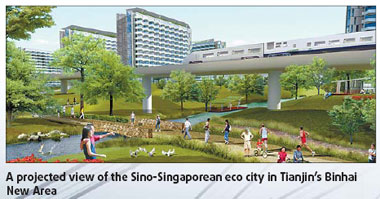
Another Green City for China

In the 9/25/2008 issue of "China Daily," there is an article titled "China Singapore Team Up on Green City Project."

China, in cooperation with Singapore, is looking to build a new, green city on a piece of land that would otherwise be unsuitable for habitation.

From the article: "The eco city is located in Tianjin's Binhai New Area. It will cover a total of 30 sq km - 20 sq km in Hangu district and 10 sq km in Tanggu district. It is 15 km from the central part of the Binhai New Area, 45 km from downtown Tianjin, and 150 km from Beijing."

The planners are estimating a population of approximately 350,000 when complete in 10-15 years. Additionally, it will have five commercial centers.

From a sustainability point of view, "Clean energy and renewable energy resources - such as wind power, solar energy, underground heat pump and air source heat pump - will reduce carbon emissions in the city. All the buildings in the eco city will have to conform to green architectural design standards." Green roofs are included in the design.

This is the latest in a green building boom in China. Shanghai working on a green roof program, Dongtan is the green city in southern China, and Songjiang, the new green resort being built. In each of these cases, green roofs play a key role in reducing air pollution, the urban heat island effect, storm water runoff, as well as improved energy efficiency.

Thursday, October 2, 2008

Green Cincinnati

Cincinnati, Ohio, in the American heartland, is aiming to become a leader in both commercial and residential green roofs.

In an Associate Press story, found on CBS News,

"The City Council on Wednesday became the first in Ohio with a plan to channel grants and loans to residents and businesses to replace tar and shingles with vegetation."

The City Council has recognized the benefits of green roofs, namely storm water runoff management, reduced fine particulate matter air pollution, as well as reducing the urban heat island effect.

The article points out the "how" of how to manage the increased costs of green roofs. Specifically,

"About $5 million a year in below-market-rate loans through the U.S. EPA Clean Water State Revolving Fund will be available starting in 2009 for green roof projects, city officials estimate, along with an undetermined amount of grant money from other EPA funds."

Perhaps this project will be commercial focus on the benefits of green roofs and encourage interest. The key to green roof acceptability is commercial viability. Let's hope that increased visibility and proper marketing can drive demand and bring down prices.

Thursday, September 25, 2008

China's Green Resort

China is one of the fastest growing economies in the world and suffers the effects of that rapid growth. Air pollution and storm water runoff effect their major and minor cities.

The Chinese government has acknowledged these problems and has taken steps to improve the situation. One way is through green roofs.

Shanghai has defined targets for the number green roofs (details here) and design firms are lining up for cities' worth of opportunity.


Outside of Shanghai, in the Songjiang district, Atkins has designed the "Songjiang Garden City," with a resort as the focal point. According the Greenroofs.com:

The innovative design of the 400-bed resort hotel stands two levels higher than the rock face of the 100 metre deep quarry and includes underwater public areas and guestrooms... Sustainability is integral to the design ranging from using green roofing for the structures above the ground level to geothermal energy extraction.


As this is part of a larger project, as mentioned above, I will be conducting an interview with Atkins Design to learn more. Until I publish the interview, Greenroofs.com and Atkins both have good articles about this project.

Tuesday, September 16, 2008

Greening Kuwait

Lest people believe that green roofs are only used in Mexico City, Shanghai, Dongtan, or Chicago, Atkins Design of Epsom, UK has "...recently received the honour of CNBC Arabian Property Award High Rise Architecture Award" for the Al Sharq Office Complex in Kuwait. This was reported in World Architecture News.com.

From the article:

"The Al Sharq office building quietly pursues a rigorous sustainability agenda. A shallow plan office floor plate with heavily shaded facades reduces the tower's environmental footprint... The 180m tower will cover an area of 56,400sq.m and ... offers a variety of scenarios for business within a sustainable and environmentally responsible design."

As one can see from the artist's rendition, there will be what are refered to as "roof gardens" to provide shade and fresh air. While not displayed, this author hopes some form of green roof will be available, though given the climate, watering would be required.

Although storm water runoff management is not as significant an issue in Kuwait as it would be in Chennai, the reduction of fine particulate air pollution is certainly a benefit.

Jetsongreen.com
provides this quotation from Nicholas Bailey of Atkins: "This is a green building - literally - because of its foliage camouflage. Vertical fins to the street elevation, formed in colored glass, are fitted with integrated solar panels that contribute to the building's energy needs."

One hopes that other countries such as the U.A.E., Qatar, and Saudi Arabia consider using green roofs and green building in their current and future construction.

Thursday, September 11, 2008

Not Just Any Green Roof

What interesting times we live in! I read an article in "The Economic Times," an Indian newspaper, titled "Green Roofs differ in Capacity to Cool Interiors." It discusses the green roof studies going on a the University of Texas.

At UT, there is the Lady Bird Johnson Wildflower Center that is hosting how different types of roofs impact temperature inside structures. In particular, they have built several identical steel structures and put different kinds of roofs on them and are measuring the temperatures and water retention.

Studies are clearly indicating that green roofs definitely reduce internal temperatures. From the article:

"During one 91-degree day, ... a black topped box without air conditioning reached 129º inside. Meanwhile, the green roof replicas produced indoor temperatures of 97 to 100 degrees F. "That's a huge difference to have a 20-or-so degree temperature drop," Simmons said, noting that green roofs' ... are also believed to double the lifespan of roofing material. "

However, in places like India and Texas, where flash flooding and storm water runoff are serious issues, different green roof materials perform better than others. Again, from the article, "Yet this feature varied the most among the six manufacturers. The better green roofs retained all of the water during a half-an-inch rainfall, and just under half the water when two inches of rain fell. "

Let's hope that the studies at UT, combined with the innovation in synthetic soil by Suntory, will spread the acceptance and use of green roofs world wide, as their ability to reduce air pollution and storm water runoff make a real difference!

Thursday, July 24, 2008

Green Roofs Help India

Without a doubt, India is one of the fastest growing economies and populations in the world. However, India suffers many of the same problems as the rest of the developing world, namely, air pollution, a shortage of regular power, as well as storm water management issues.

To help combat these problems and provide a better life for all Indians, green roofs are beginning to appear. In an article found on India Together, the author spells out how the building boom in India mirrors Western, upscale properties. He also mentions that all of the luxury amenities in these buildings consume more and more power. Not to be left behind government buildings are also energy hogs.

This is where green building and green roofs come in. Green roofs will help reduce cooling costs for the new buildings by about 20%. Additionally, less strain will be put on the water system by the effective storm water runoff management that the green roofs supply. Were that not enough, the green roofs will also help filter fine particulate matter air pollution out of the air, making the area more livable.

Green roofs are a cost effective solution to many of India's, and the developing world's problems. As the word spreads that green buildings produce great benefits, hopefully, more countries will have them.

Green Roofs Control Storm Water Runoff

As I have mentioned in previous posts, the benefits of green roofs include reduced utility costs, reduced heat island effect, reduced air pollution, and reduced storm water runoff. In cities close to major bodies of water where storm water runoff is a major concern, green roofs can be used to help mitigate that concern.

In an article in Environmental Health Perspectives, Washington DC was sued to reduce storm water runoff in 2002. As part of the settlement, "...the DC Water and Sewer Authority provided $300,000 for green roof development....Those funds, managed by the nonprofit Chesapeake Bay Foundation, seeded a program of incentive grants that encouraged eight builders to choose green roofs over other traditional devices as their primary stormwater control device (stormwater control plans are required for any new construction or redevelopment of more than 5,000 square feet in the District)."

Clearly, the District takes this issue very seriously. Green roofs are becoming more popular in Washington, DC. Hopefully, more federal buildings will look like Chicago's City Hall.

Thursday, July 17, 2008

LEED With Green Roofs

Green roofs help builders and buildings get Platinum LEED certification. The picture, above, is the Northern Arizona University Applied Research and Development building, located in Flagstaff, AZ.

LEED stands for Leadership in Energy and Environmental Design, and is trademarked by the US Green Building Council (USGBC). The USGBC defines LEED as:

LEED is a third-party certification program and the nationally accepted benchmark for the design, construction and operation of high performance green buildings.

The certification and rating system is done by consensus of the various LEED committees.

Relative to building, a flat green roof helps to meet LEED standards for energy consumption, carbon footprint reduction, and storm water runoff reductions. Additionally, flat green roofs reduce fine particulate matter air pollution. While LEED recognizes the building as a system, a flat green roof is a great addition to improve both the building and its certification.

Tuesday, July 15, 2008

George Washington University Gets a Green Roof

Green roofs can improve air pollution, reduce fine particulate matter, and reduce storm water runoff. Additionally, flat green roofs reduce heating and cooling cost, thus reducing energy consumption.

George Washington University's School of Business is putting a flat green roof at the Elliott School of International Affairs City View Room Terrace this summer (2008). This news was reported in the GWSB newsletter.

GWSB M.B.A. student Brett Kaplan, helped secure funding for GW’s first-ever campus flat green roof. "This project is important to GW because it a major step forward in terms of enhancing the school’s sustainability profile. Aside from the environmental benefits, the green roof is designed to stand as a visual symbol of GW’s commitment to sustainability. The roof is meant to be a stepping stone for other green campus initiatives. If students, for instance, see that it’s possible to get this particular initiative passed, they will feel like their own campus greening ideas can also be brought to life, Kaplan said."

Not only is the building a commitment to sustainability, but it also will be used for educational purposes. The University is also going to use it as a show piece demonstrate its commitment to green technology and sustainability.

The 2,000 square foot roof is estimated to cost $25,000, 70% of which will be provided by the university. Grants and support from the student environmental association will provide the other 30%.

Sunday, July 13, 2008

Green Roofs for Homes

Green roofs aren't just for commercial buildings, but rather for every building that can sustain one. The really good things about green roofs apply to homes, just as they do to other buildings. They reduce heating and cooling costs, reduce storm water runoff, and also reduce air pollution.

I found some basic instructions and images at Natural Life Network

Here they are:

Simple Design Overview

The basic design and construction of a green roof can be quite simple and inexpensive. Given the additional loads that a green roof requires engineering will be required to ensure the correct level of support structure. The basic design of a green roof is as follows:

  1. Plywood layer on top of roof trusses or joists (some slope is required for drainage, too much slope may be difficult to cultivate due to erosion).
  2. Apply a synthetic rubber membrane on top of the plywood roofing structure. Up to this point you have basically created a common industrial roof.
  3. In order to retain the soil the roof must provide a containing edge from four to eight inches high, also covered by synthetic rubber. Don't forget to leave some drainage scuppers.
  4. Once the base roof water proofing system is in place the additional green roof components can be added when ready.
  5. The first layer of the green roof is typically a foundation membrane (a dimpled "Delta" membrane or something similar that can catch and retain some water in the little cups.
  6. Add a landscaping root barrier membrane. Apply the all membranes from bottom to top and ensure layers overlap with upper (higher) layers on top of lower layers. (The same way you shingle a house).
  7. Around the drainage zones create a drainage area as you would around the foundations of a house, with gravel and drainage tubing.
  8. Fill in with soil from four to six inches.
  9. Use straw mats tucked under the soil to reduce erosion as the soil begins to grow plants in it.

Check out www.GreenRoofs.com

Well Done!

Wednesday, July 2, 2008

Germans Love Green Roofs!

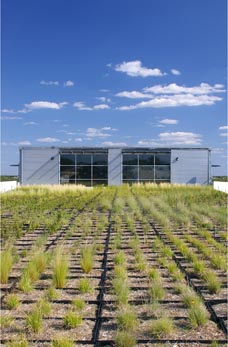
According to Michigan State University, Germany has the highest density of flat green roofs. As the picture demonstrates, flat green roofs can be simple in design, and can easily fit into both the man-made and natural landscape.

If one googles "green roof Germany," one will find article upon article about the rise of flat green roofs in the 1970s in Germany to combat storm water runoff. Having had friends in Germany, they told me how expensive water was and how the government was trying ways to capture water from roadways and other sources.

Hat's off to Germany and their flat green roofs! Notice there were no David Hasselhoff jokes?

Thursday, June 26, 2008

Green Roofs in China, Helping Beijing Breathe

The greatest inspiration for me to blog about green roofs was my trip to Shanghai, China in January of 2008. There I saw incredible air pollution, which literally was choking.

While I sat in several different office buildings, many stories into the skyline, I observed huge swaths of flat roofs, mostly black, sitting idle. Additionally, I remembered the discussion about how energy starved Shanghai is, as well as concerns about water.

As one of my meetings ran long, and somewhat boring, I began to map out a strategy of how Shanghai could adopt flat green roofs, reduce air pollution, and minimize storm water runoff. I admit, the plan was grandiose, so that's why I settled on a blog instead.

It turns out that in 2006, several stories ran about green roofs in Beijing, where, according to the US embassy, has worse air pollution than Shanghai. Here are some quotes from articles at that time. There is also a nice mention of LEED in there.

"The Beijing Linked Hybrid project, a self-contained city of linked vertical buildings designed by Holl, includes hundreds of apartments as well as stores and schools, and every roof is green. Storm water collected in rooftops will help feed a self-sustaining water system to protect the buildings against water shortages in Beijing, Holl explained.

"They want it and they're willing to pay for it," Holl said of his Chinese clients.

China launched a nationwide drive last month to make energy-saving buildings that help ease fuel shortages and reduce greenhouse gases. The country has also signed an agreement with the United Nations to promote environmentally friendly practices in staging the 2008 Beijing Olympics."
from "Landscape architects tend to a green roof" found at http://www.msnbc.msn.com/id/12512892/.

From the Christian Science Monitor:

""There isn't much pressure for us to promote the green concept," said science ministry official Yang Guoxiong at last week's green inauguration.

"The national government has incredible intentions for a green future." says Mr. Mars. "Really mind-boggling. But we are in an interesting paradox, and I am asking, 'Is it better to have high ambitions, or to be realistic?' " http://www.csmonitor.com/2006/0403/p07s02-woap.html

Let's hope the rest of China can catch the green roof wave and bring clean air to their cities and citizens.

Sunday, June 8, 2008

Chicago is Using Green Roofs!

Chicago is using a grant for the US Environmental Protection Agency to study green roofs. A green roof has been planted on the City Hall building. According to the EPA:

Projected total direct electricity savings were 9,272 kilowatt-hours per year, and the corresponding savings in natural gas for heating were 7.372 therms per year. (This calculation compares the base case R-value, or thermal resistance value To definition provided on the glossary page , of 5.9 with the treated roof – garden and insulation – R-value 21.2.)

Additionally, the article provides specific details as to the plant life as well as the construction methods and materials.

In major cities, such as Chicago and New York City, the city government imposes a tax on the amount of storm water runoff each building contributes.

Green roofs in these cities help reduce that tax by having the green roof system store and use the storm water.

Additionally, green roofs add to property values, as they reduce the heating and cooling costs, as well as providing additional aesthetic appeal.

Saturday, June 7, 2008

Cleaner Air For Cities

The air quality of the world's largest cities is a tragedy. If you are among the many people who believe there has to be a cost-effective, sustainable, and relatively simple way to have cleaner air in cities, you have come to right place. People since the Babylonians have enjoyed both the aesthetic value and positive environmental qualities of green roofs. In the simplest terms, a green roof is a roof that has plant life on it. The plant life helps to cool structures, capture stormwater (reducing runoff), as well as reducing carbon dioxide from the air. Additionally, the plant life on the green roof can help remove particulate matter from the air.

In recent years, as fears of climate change have reached a fever pitch, many have looked to the cost-effective proposition of green roofs. This blog seeks to study and promote the concept of green roofs, as well as adding to the literature and science.